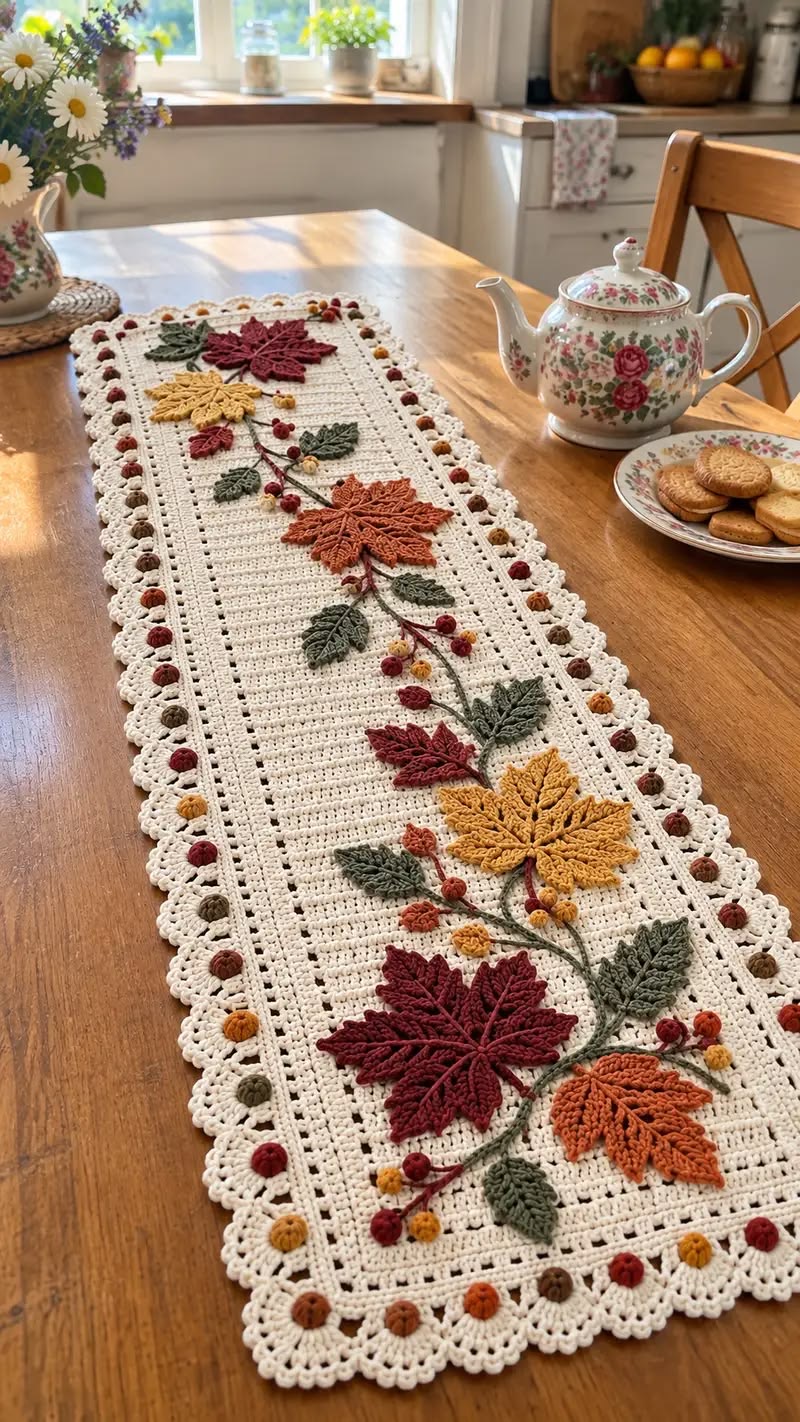
Create a beautiful autumn-inspired crochet table runner featuring colorful maple leaves, delicate berries, winding vines, and an elegant scalloped lace border. This handmade centerpiece is perfect for fall decorating, Thanksgiving tables, farmhouse kitchens, and seasonal home décor.
Skill Level: Intermediate to Advanced Terminology: US Crochet Terms Finished Size: Approximately 14 × 48 inches (36 × 122 cm), adjustable Construction: Rectangular crochet base with separately crocheted maple leaves, small foliage, berries, embroidered vines, and decorative lace edging.
Pattern note: This is an original, photo-inspired reconstruction, not the designer’s exact original pattern. The instructions provide a practical way to recreate the appearance.
1. Materials Needed
Yarn
Use DK-weight or light worsted-weight cotton yarn in the following colors:
- Ivory or Cream: 600–800 yards for the runner base and lace border
- Burgundy: 100 yards for large maple leaves and berries
- Mustard Yellow: 100 yards for autumn leaves
- Burnt Orange: 100 yards for maple leaves
- Rust Red: 70 yards for smaller leaves
- Sage Green: 100 yards for foliage and vines
- Brown: 30 yards for decorative berries
- Golden Yellow: 30 yards for additional berries
Tools
- 3.5 mm crochet hook
- 3.0 mm crochet hook for smaller appliqués
- Yarn needle
- Stitch markers
- Sharp scissors
- Measuring tape
- Blocking mat and rustproof pins
2. Crochet Abbreviations
| Abbreviation | Meaning |
| ch | Chain |
| sc | Single crochet |
| hdc | Half double crochet |
| dc | Double crochet |
| tr | Treble crochet |
| sl st | Slip stitch |
| st(s) | Stitch(es) |
| sp | Space |
| rep | Repeat |
| BLO | Back loop only |
| RS | Right side |
| WS | Wrong side |
| MR | Magic ring |
Special stitches
Picot: Ch 3, sl st into the first chain.
Shell: Work 5 dc into the indicated stitch or space.
Popcorn stitch: Work 5 dc into the same stitch, remove the hook, insert it into the first dc, pull the working loop through, and ch 1 to secure.
3. Main Crochet Table Runner Base
The foundation is a flat ivory rectangle with neat horizontal rows and a subtle handmade texture.
Foundation
Using ivory yarn and a 3.5 mm hook:
Ch 61.
Row 1: Work 1 dc in the fourth chain from the hook and 1 dc in each remaining chain. Turn.
You should have 59 dc, counting the turning chain as a stitch.
Row 2: Ch 2 (does not count as a stitch), work 1 hdc in each stitch across. Turn. (59 hdc)
Row 3: Ch 3 (counts as first dc), skip the first stitch, dc in each remaining stitch. Turn. (59 dc)
Row 4: Ch 1, sc in each stitch across. Turn. (59 sc)
Row 5: Ch 3 (counts as dc), skip the first stitch, dc in each remaining stitch. Turn. (59 dc)
Rows 6–110: Repeat Rows 2–5 in sequence until the rectangle measures approximately 45 inches long, or your preferred length.
The row count is a guide; gauge determines the finished dimensions.
Fasten off and weave in the ends.
Optional textured variation
For a more pronounced woven appearance, replace occasional hdc rows with BLO hdc rows. This creates gentle raised ridges similar to the photographed fabric.
4. Inner Decorative Openwork Border
The photograph features delicate openwork framing the central rectangle.
Join ivory yarn at any corner with the right side facing.
Round 1: Ch 1, sc evenly around all four sides, working 3 sc into each corner. Sl st to the first sc.
Make sure your stitch spacing allows the rectangle to lie flat.
Round 2: Ch 3, skip 1 st, dc in the next st, ch 1, skip 1 st. Repeat this mesh sequence around, adjusting at corners with (dc, ch 2, dc) in the center corner stitch.
Sl st to join.
Round 3: Ch 1, sc in each dc and ch-1 space. Work 3 sc in each corner ch-2 space. Join.
Round 4: Repeat Round 2 to create the second decorative eyelet line.
Round 5: Ch 1, work sc evenly around, adding corner stitches as necessary to keep the fabric flat.
Fasten off.
5. Large Autumn Maple Leaf Appliqué
Make 5–7 large leaves in burgundy, mustard yellow, and burnt orange.
The main decorative elements are dimensional maple-style leaves with pointed lobes and embroidered veins.
Leaf center
Using a 3.0 mm hook and your chosen autumn color:
Round 1: Make a magic ring, ch 1, work 10 sc into the ring. Join with sl st. (10 sc)
Round 2: Ch 2, work 2 hdc in each stitch around. Join. (20 hdc)
Round 3: Ch 1, repeat (sc in next stitch, 2 sc in next stitch) around. Join. (30 sc)
Do not fasten off.
Shape the five leaf lobes
Each leaf lobe is built outward from the center. Work into five evenly spaced pairs of stitches from Round 3.
For each lobe:
- Join the working yarn at the designated starting stitch.
- Ch 9.
- Sc in the second chain from the hook.
- Hdc in the next chain.
- Dc in the next 2 chains.
- Tr in the next 2 chains.
- Dc in the next chain.
- Hdc in the last chain.
- Sl st into the next available stitch on the center circle.
This makes the first side of a pointed petal.
To develop the opposite side and add texture, work back along the exposed edge of the chain:
- Sc in the first available edge loop.
- Hdc in the next loop.
- Dc in the next 2 loops.
- Tr in the next 2 loops.
- Dc in the next loop.
- Work (sc, ch 3, sl st into first ch, sc) at the tip to form a point.
- Work sl sts back toward the center as necessary.
Repeat for four additional lobes, spacing them around the central circle.
For a more natural maple shape, vary the lobe lengths:
- Top center lobe: ch 11
- Upper side lobes: ch 9
- Lower side lobes: ch 7
Adjust the return-side stitch sequence to match the longer or shorter chain.
Leaf edging
Join yarn at the bottom of the leaf.
Work sc evenly around the complete outer edge. At every pointed tip, work (sc, ch 2, sl st into first ch, sc).
Fasten off, leaving a long tail for sewing.
Raised leaf veins
Using matching yarn or a slightly darker shade:
- Sew a central stem line from the base toward the top lobe.
- Add diagonal branches extending into each side lobe.
- Work the veins using surface slip stitches or embroidery chain stitches.
- Pull the yarn gently to create dimensional ridges without distorting the leaf.
The resulting leaf should have five distinct pointed sections and visible raised veins.
6. Small Autumn Leaf Appliqué
Make 8–12 smaller leaves.
Use burgundy, green, rust, and mustard yarn.
Row 1: Ch 11.
Row 2: Starting in the second chain from the hook, sc, hdc, dc in next 2 chains, tr in next 2 chains, dc in next 2 chains, hdc, sc.
Row 3: Ch 2, rotate the work and crochet along the opposite side of the foundation chain: sc, hdc, dc in next 2 stitches, tr in next 2 stitches, dc in next 2 stitches, hdc, sc.
Join at the base.
Serrated edge
Work around the perimeter, placing the following sequence where space permits:
(sc, ch 2, sl st in first ch), sc in the next edge stitch.
Repeat to create small decorative points.
Center vein
Surface crochet a line from the base to the leaf tip.
Add two or three small diagonal embroidered veins on each side.
Fasten off and leave a sewing tail.
7. Crochet Autumn Berries
Make approximately 35–50 berries in burgundy, rust, yellow, orange, brown, and olive.
Small round berries
Using a 3.0 mm hook:
Round 1: Make a magic ring, work 6 sc into the ring. (6)
Round 2: Work 2 sc in each stitch. (12)
Round 3: Sc in each stitch around. (12)
Round 4: Repeat (sc 2 together) six times. (6)
Before closing completely, add a tiny amount of polyester stuffing or a short yarn scrap.
Fasten off, thread the tail through the remaining six stitches, pull closed, and secure.
For flatter berries that are easier to sew to the runner, omit the stuffing and gently flatten the crocheted shape.
Larger decorative berries
For larger berries, use this variation:
Round 1: 6 sc in MR.
Round 2: 2 sc in each stitch. (12)
Round 3: (sc, 2 sc in next stitch) six times. (18)
Round 4: Sc around. (18)
Round 5: (sc, sc2tog) six times. (12)
Round 6: Sc2tog six times. (6)
Close and secure.
Make berries in several shades to create the autumn color effect visible along the border.
8. Winding Crochet Vine
The leaves in the reference design are connected by an elegant green vine running along the runner’s center.
Using sage green yarn and a 3.0 mm hook:
Ch 180–220, or enough to create a gently winding vine along the length of the runner.
Starting in the second chain from the hook, sl st in every chain to the end.
Fasten off, leaving a long sewing tail.
For a thicker vine, work sc along the chain instead of sl st.
Branching stems
Create 8–12 short stems of different lengths:
- Short stems: ch 8–12
- Medium stems: ch 15–20
- Long stems: ch 22–28
Work sl sts back along each chain.
Sew these branching stems to the main vine, extending toward the maple leaves and berries.
Alternatively, embroider the vines directly onto the table runner with chain stitch or stem stitch for a flatter, more secure finish.
9. Decorative Bobble Lace Border
This border is an important feature of the design: scalloped cream lace framing small multicolored bobbles.
The following construction offers a similar appearance with repeatable crochet stitches.
Round 1: Border foundation
Join ivory yarn.
Work sc evenly around the runner, with 3 sc at each corner.
Round 2: Open chain spaces
Ch 1, sc in the first stitch.
Repeat (ch 3, skip 2 stitches, sc in the next stitch) around the runner.
At corners, work a larger ch-5 loop to prevent pulling.
Join with sl st.
Round 3: Decorative lace arches
Sl st into the first ch-3 space.
Work (sc, 5 dc, sc) in each ch-3 space around the border.
At the corner ch-5 spaces, work (sc, 7 dc, sc).
Join.
Round 4: Picot scallops
Work along the outer edge of each shell.
For each 5-dc shell:
Sc in the first dc, hdc in the second dc, (dc, picot, dc) in the third dc, hdc in the fourth dc, sc in the fifth dc.
Work a sl st between adjacent shells.
For the larger corner shells, distribute the stitches evenly and place a picot at the center.
Fasten off and weave in ends.
Adding the colored bobbles
Make 45–65 small colored berries using the flat version from Section 7.
Arrange them evenly along the border, directly inside the scalloped edging.
Alternate colors naturally:
Burgundy → Mustard → Olive → Rust → Brown → Burgundy.
Sew each berry securely onto the lace foundation, taking care not to cover the open spaces.
10. Assembling the Autumn Leaf Design
Before sewing, lay the finished runner flat on a large surface.
Position your autumn decorations along the cream center panel.
Suggested layout
| Position | Decoration |
| Top section | Burgundy maple leaf, mustard leaf, green foliage |
| Upper middle | Burnt-orange maple leaf with berries |
| Center | Burgundy and mustard leaves |
| Lower middle | Large burgundy maple leaf and green foliage |
| Bottom section | Burnt-orange leaf, green foliage, berry branches |
Place the longest sage-green vine in a gentle S-curve along the runner.
Connect the leaves with shorter stems and arrange small berries at different points along the vine.
Avoid placing all the leaves in a perfectly straight line. The reference has an organic, flowing composition.
Sewing instructions
- Pin all the leaves, stems, and berries into position.
- Sew the main vine onto the runner using small, nearly invisible stitches.
- Attach the larger leaves through their centers and along the bases of their lobes.
- Add the smaller leaves between the larger maple leaves.
- Stitch the individual berry clusters along the vines.
- Hide all yarn ends on the wrong side.
For additional three-dimensional texture, sew only the central area of each leaf while leaving portions of the outer lobes slightly raised.
11. Finishing and Blocking
Blocking will help produce a professional, evenly shaped table runner.
- Gently soak the finished runner in lukewarm water with a small amount of mild detergent.
- Rinse carefully and press out excess water without twisting.
- Lay the runner flat on blocking mats.
- Shape the rectangle, straighten the inner mesh borders, and open the scalloped lace.
- Arrange the maple leaf points naturally.
- Pin the outer scallops into a consistent shape.
- Allow the entire project to dry completely.
For a runner with raised berries and leaves, avoid pressing a hot iron directly onto the appliqués.
12. Customization Ideas
Classic Autumn: Burgundy, mustard yellow, burnt orange, sage green, and ivory.
Elegant Neutral: Cream, taupe, caramel, chocolate brown, and muted olive.
Thanksgiving Style: Pumpkin orange, deep red, golden yellow, forest green, and warm ivory.
Modern Farmhouse: Soft beige, terracotta, dusty rose, sage, and off-white.
You can also make matching placemats by shortening the rectangle and using one or two maple leaves in the center.
13. Pattern Adjustments
To make a longer table runner
Continue repeating the base rows until the desired length is reached, then extend the vine and distribute additional leaves along the center.
To make a wider runner
Begin with a longer foundation chain, keeping the number of base stitches consistent throughout the rectangle.
To make a lighter runner
Use sport-weight cotton yarn and a 2.5–3.0 mm hook for a finer, more delicate finish.
To make a thicker runner
Use worsted-weight cotton yarn and a 4.0 mm hook, adjusting the number of rows and stitches for your required dimensions.
14. Crochet Tips for Professional Results
- Use cotton yarn for stitch definition and a flat, structured table runner.
- Keep the leaf tension firm to maintain clearly defined maple shapes.
- Crochet and block one sample leaf before making the entire set.
- Use a consistent stitch count in the base to keep the long edges straight.
- Attach the raised leaves securely enough for practical everyday use.
- Make the border berries in different colors and slightly different sizes for an authentic handcrafted appearance.
- Position the decorative vine and leaves before permanently attaching them.
15. Final Result
Your completed Autumn Maple Leaves Crochet Table Runner will feature an ivory textured background, colorful raised maple leaves, delicately branching green vines, clusters of autumn berries, and a decorative scalloped lace border.
The combination of warm seasonal colors, floral-style appliqués, and handmade crochet detailing creates an elegant centerpiece for dining tables, sideboards, coffee tables, and festive Thanksgiving settings.
Leave a Reply